

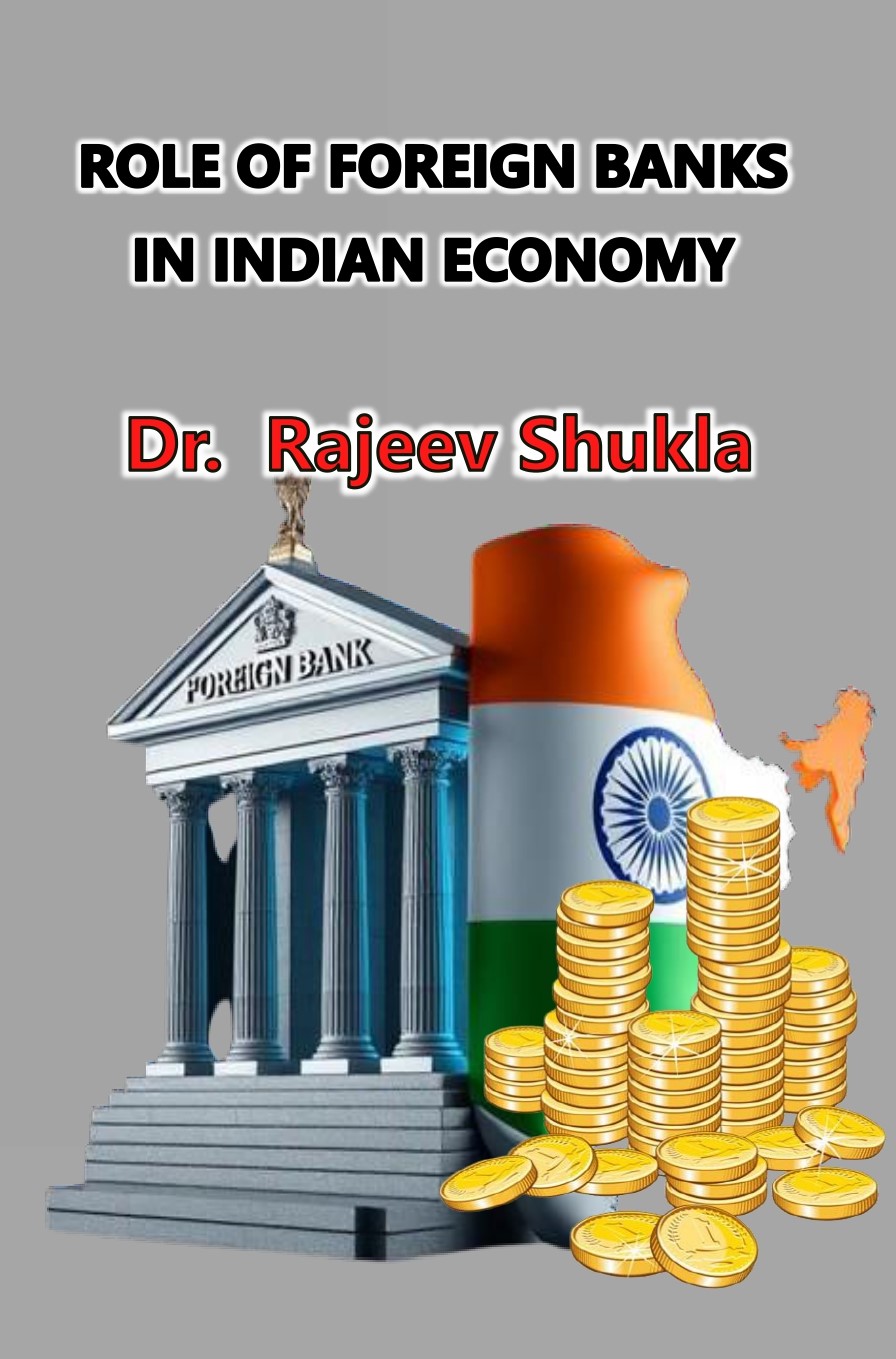

Role of Foreign Banks in Indian Economy By Dr. Rajeev Shukla
Original price was: ₹649.00.₹249.00Current price is: ₹249.00.
The evolution of banking in India is a fascinating narrative woven into the broader tapestry of the nation’s economic and political history. Among the many chapters in this story, the role of foreign banks stands out as both controversial and consequential. Since the early 19th century, these institutions have operated in India, primarily as branches of global financial entities, shaping and facilitating the country’s international trade relations. Even today, they remain key players in India’s financial landscape.
Yet, their legacy is complex. For many, the presence of foreign banks evokes memories of colonial-era exploitation and questionable practices, as documented in various testimonies, including those presented before the Central Banking Enquiry Committee. The call for their exclusion post-Independence was not uncommon, and debates over their role in India’s economy continue to surface even in the modern era. In the wake of liberalization and the recommendations of the Narasimha Committee on the financial system, the Reserve Bank of India (RBI) in 1993 introduced a new framework that allowed greater participation of foreign banks in the Indian economy albeit under a more regulated and equitable set of conditions, bringing them on par with domestic commercial banks.
This book is an attempt to explore and critically assess the performance, contributions, and implications of foreign banks operating in India during the post-liberalization period, with particular focus on the years 2002 to 2008. Relying exclusively on secondary data, primarily sourced from the Reserve Bank of India, the study undertakes a comparative analysis of various operational metrics—deposits, borrowings, advances, profits, and investments to map the influence of foreign banks within the broader Indian banking sector. These metrics are evaluated using established quantitative tools including ratios, trend analysis, and cost-benefit assessments. Divided into nine chapters, the book takes the reader through a structured journey: from an introduction to the role of foreign banks and the globalization of the Indian economy, through the channels of resource mobilization and credit deployment, and finally to an impact analysis and forward-looking suggestions.
This work aims not just to document but also to provide a balanced perspective on the significance and challenges of foreign banks in a rapidly transforming Indian economy. It is my hope that researchers, policymakers, financial analysts, and curious readers alike will find the insights contained herein both informative and thought-provoking.
Description
The evolution of banking in India is a fascinating narrative woven into the broader tapestry of the nation’s economic and political history. Among the many chapters in this story, the role of foreign banks stands out as both controversial and consequential. Since the early 19th century, these institutions have operated in India, primarily as branches of global financial entities, shaping and facilitating the country’s international trade relations. Even today, they remain key players in India’s financial landscape.
Yet, their legacy is complex. For many, the presence of foreign banks evokes memories of colonial-era exploitation and questionable practices, as documented in various testimonies, including those presented before the Central Banking Enquiry Committee. The call for their exclusion post-Independence was not uncommon, and debates over their role in India’s economy continue to surface even in the modern era. In the wake of liberalization and the recommendations of the Narasimha Committee on the financial system, the Reserve Bank of India (RBI) in 1993 introduced a new framework that allowed greater participation of foreign banks in the Indian economy, albeit under a more regulated and equitable set of conditions, bringing them on par with domestic commercial banks.
This book is an attempt to explore and critically assess the performance, contributions, and implications of foreign banks operating in India during the post-liberalization period, with particular focus on the years 2002 to 2008. Relying exclusively on secondary data, primarily sourced from the Reserve Bank of India, the study undertakes a comparative analysis of various operational metrics—deposits, borrowings, advances, profits, and investments—to map the influence of foreign banks within the broader Indian banking sector. These metrics are evaluated using established quantitative tools, including ratios, trend analysis, and cost-benefit assessments. Divided into nine chapters, the book takes the reader through a structured journey: from an introduction to the role of foreign banks and the globalization of the Indian economy, through the channels of resource mobilization and credit deployment, and finally to an impact analysis and forward-looking suggestions.
This work aims not just to document but also to provide a balanced perspective on the significance and challenges of foreign banks in a rapidly transforming Indian economy. It is my hope that researchers, policymakers, financial analysts, and curious readers alike will find the insights contained herein both informative and thought-provoking.
Related products
-
Sale!

India’s foreign policy emerging trends & Challenges By Dr. Aashish Kumar Bariyar
Original price was: ₹1,199.00.₹399.00Current price is: ₹399.00. Add to basket -
Sale!

राजनीतिक सिद्धांत में समकालीन बहसें by डॉ. ख्यातिमय त्रिपाठी
Original price was: ₹270.00.₹49.00Current price is: ₹49.00. Add to basket -
Sale!

सशक्तिकरण की गूंज महिलाएं, समाज और राजनीतिक सुधार (खंड – १) by डॉ. संजीव कुमार गंगवार
Original price was: ₹499.00.₹199.00Current price is: ₹199.00. Add to basket -
Sale!

Values and Good Citizenship by Dr. K. Tripathy
Original price was: ₹199.00.₹19.00Current price is: ₹19.00. Add to basket
Reviews
There are no reviews yet.