

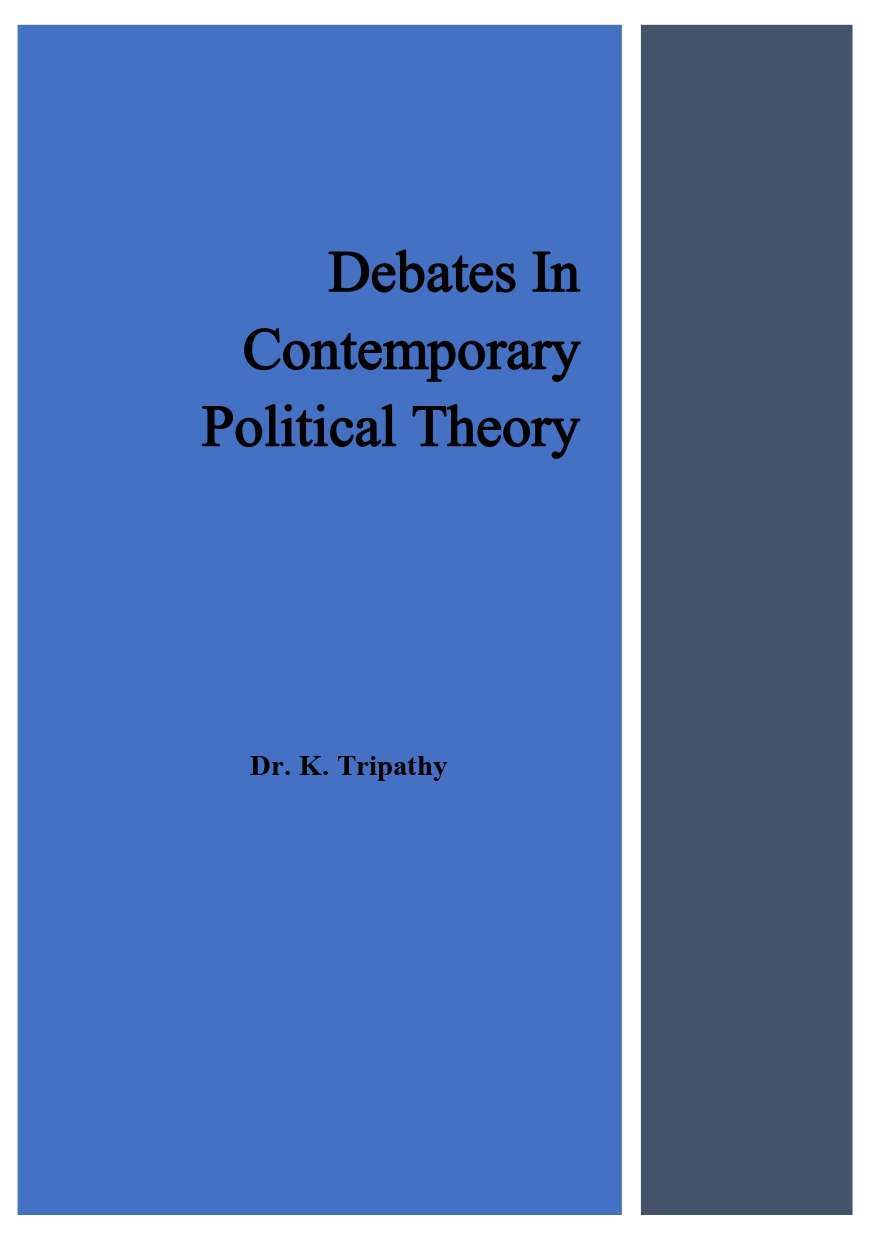
Debates in Contemporary Political Theory by Dr. K. Tripathy
Original price was: ₹499.00.₹49.00Current price is: ₹49.00.
“Debates in Contemporary Political Theory” by Dr. K. Tripathy is an incisive exploration of modern political thought, tackling key ideological and philosophical discussions that shape contemporary political landscapes. Dr. Tripathy systematically addresses pivotal debates surrounding democracy, justice, power, and identity, providing a critical examination of both classical and emerging theories. The book delves into the works of influential political theorists and contrasts their perspectives, fostering a deeper understanding of the complexities and nuances within current political discourse. With rigorous analysis and insightful commentary, Dr. Tripathy’s work serves as a crucial resource for students, scholars, and anyone interested in the evolving dynamics of political theory.
Description
Debates in Contemporary Political Theory FINAL“Debates in Contemporary Political Theory” by Dr. K. Tripathy is a comprehensive exploration of the prevailing discourses within modern political thought. The book meticulously dissects a variety of ideological, normative, and methodological debates that shape contemporary political theory. Dr. Tripathy, a noted scholar in political philosophy, brings clarity and depth to complex theoretical discussions, making this work an invaluable resource for students, academics, and anyone interested in the intricate workings of political ideas in the modern world.
The book is structured thematically, covering key debates that have emerged over recent decades. Dr. Tripathy begins by addressing the foundational principles of political theory, such as justice, equality, and liberty. These concepts are not merely presented in isolation but are contextualized within the broader historical and philosophical traditions that have influenced their development. For instance, the discussion on justice delves into the contributions of John Rawls, whose theory of justice as fairness has been a cornerstone of contemporary political thought. Dr. Tripathy critically engages with Rawls’ ideas, examining both the strengths and criticisms of his approach and juxtaposing it with alternative perspectives such as those offered by libertarianism and communitarianism.
The book further explores the contentious debate between liberalism and its critics. Dr. Tripathy provides a detailed account of liberalism’s evolution, highlighting its emphasis on individual rights, democracy, and the rule of law. However, he does not shy away from the critiques that have been levied against liberalism, particularly by scholars from the Marxist, feminist, and post-colonial traditions. These critiques are meticulously analyzed, with Dr Tripathy demonstrating how they challenge the liberal framework on issues like social justice, gender equality, and cultural hegemony. This balanced presentation allows readers to understand the multifaceted nature of these debates and the ongoing dialogue between different schools of thought.
One of the significant contributions of this book is its examination of the role of identity in contemporary political theory. The rise of identity politics has reshaped many traditional political debates, bringing to the forefront issues related to race, gender, sexuality, and ethnicity. Dr Tripathy discusses the theoretical underpinnings of identity politics, tracing its roots to both critical theory and post-structuralism. He examines how identity has become a central axis around which many political struggles are organized and how it intersects with issues of power, representation, and recognition. The discussions on intersectionality, a concept developed by Kimberlé Crenshaw, are particularly insightful, as they reveal the complexity of social identities and the multiple layers of discrimination and privilege that individuals experience.
The book also delves into the debates surrounding democracy and its various interpretations. Dr. Tripathy scrutinizes different models of democracy, from deliberative and participatory democracy to more radical forms like direct democracy and agonistic pluralism. He evaluates the strengths and weaknesses of these models, considering how they address issues of inclusion, participation, and legitimacy. This section of the book is especially relevant given the contemporary challenges to democratic institutions worldwide, including the rise of populism, political polarization, and the erosion of public trust in democratic processes.
Another critical area covered in “Debates in Contemporary Political Theory” is the discourse on globalization and its impact on the state and sovereignty. Dr. Tripathy explores how globalization has transformed traditional notions of state sovereignty and the implications for political authority and governance. He discusses the emergence of global governance structures, the role of international organizations, and the tension between global and local identities. This analysis is particularly pertinent in the context of increasing transnational challenges such as climate change, migration, and economic inequality, which require coordinated responses beyond the capabilities of individual nation-states.
In addition to these thematic areas, Dr. Tripathy addresses methodological debates within political theory. He examines the merits and limitations of various approaches, including normative political theory, empirical analysis, and critical theory. This discussion is crucial for understanding how different methodologies influence the way political questions are framed and addressed. Dr. Tripathy advocates for a pluralistic approach that recognizes the value of diverse methodologies in enriching political discourse and enhancing our understanding of complex political phenomena.
Throughout the book, Dr Tripathy employs a clear and accessible writing style, making intricate theoretical debates comprehensible without oversimplifying them. His analysis is rigorous, drawing on a wide range of sources and engaging with the latest scholarly literature. This ensures that the book is not only informative but also reflective of the current state of political theory.
“Debates in Contemporary Political Theory” is an essential read for anyone interested in the dynamic and evolving landscape of political thought. Dr. Tripathy’s work stands out for its breadth and depth, offering readers a thorough grounding in the major debates that define contemporary political theory. By illuminating the ongoing dialogues and tensions within the field, the book encourages readers to critically engage with political ideas and consider their implications for contemporary political practice.
Dr. K. Tripathy’s “Debates in Contemporary Political Theory” is a pivotal contribution to the field of political theory. It provides a nuanced and comprehensive examination of the debates that shape our understanding of key political concepts and the methodologies used to study them. Through his insightful analysis and balanced approach, Dr Tripathy not only educates but also inspires readers to delve deeper into the complexities of political thought. This book is a testament to the richness of contemporary political theory and its vital role in addressing the pressing issues of our time.
Related products
-
Sale!
Who is a philosopher! by Dr. K. Tripathy
Original price was: ₹380.00.₹99.00Current price is: ₹99.00. Add to basket -
Sale!

Viksit Bharat: Issues, Challenges & Opportunities
Original price was: ₹599.00.₹199.00Current price is: ₹199.00. Add to basket -
Sale!
सशक्तिकरण की गूंज महिलाएं, समाज और राजनीतिक सुधार (खंड-2) by डॉ. संजीव कुमार गंगवार
Original price was: ₹499.00.₹199.00Current price is: ₹199.00. Add to basket -
Sale!
Youth Awareness and civic engagement: An insight from Arunachal Pradesh By Dr. Joba Riba
Original price was: ₹599.00.₹99.00Current price is: ₹99.00. Add to basket
Reviews
There are no reviews yet.